Artist- Vocals
Bruce Dickinson
 United Kingdom
1958
Paul Bruce Dickinson
Dario di Marco
United Kingdom1958
Paul Bruce Dickinson
Dario di Marco
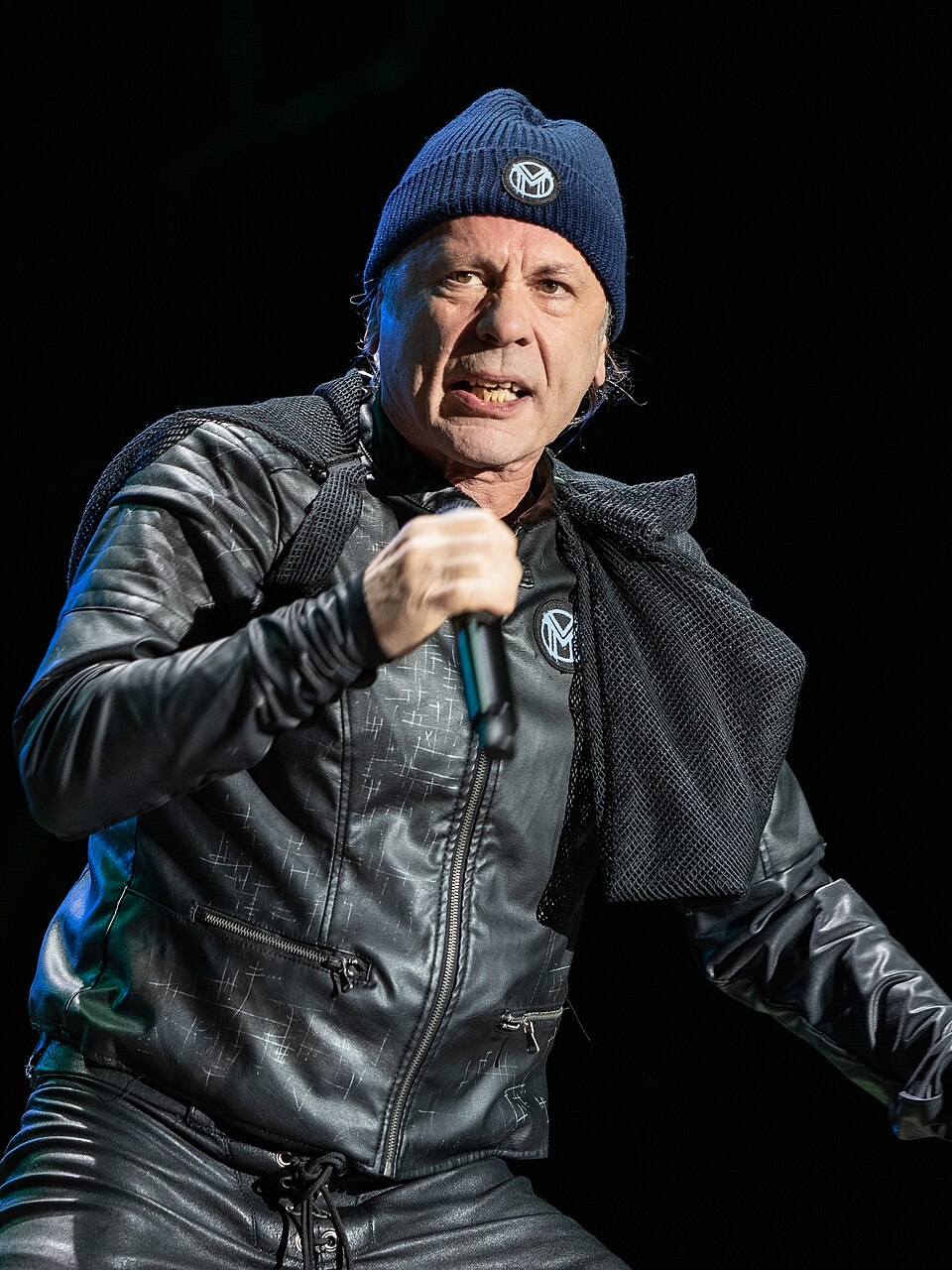
Bruce Dickinson didn't join Iron Maiden just to replace Paul Di'Anno. He came in to change the scale of what the band could be. When he took over vocals in 1981, Maiden already had an identity, repertoire and a growing following. However, there was a lack of a voice capable of taking those compositions from British clubs to the biggest arenas on the planet. Dickinson brought range, power, theatricality and a physical presence that transformed every stage into conquered territory. Before that, he had gained prominence at Samson under the name Bruce Bruce, recording his voice in *Head On* and *Shock Tactics*. The band was part of the same effervescence as the New Wave of British Heavy Metal, but offered little space for the ambition that Dickinson carried. His meeting with Iron Maiden was less a conventional signing than a collision between two forces primed to explode. A few months later, the world would hear the result. *The Number of the Beast*, released in 1982, marked their debut and immediately redefined the group's commercial and artistic reach. “Run to the Hills”, “Children of the Damned”, “Hallowed Be Thy Name” and the title track showed a singer capable of playing characters, creating tension and projecting melodies over increasingly grandiose guitars. Bruce didn't just sing the lyrics. He acted them out. Each song acquired a historical, literary or cinematographic dimension because his voice seemed to narrate events before the public, not recall stories that had already ended. On the following albums, *Piece of Mind*, *Powerslave*, *Somewhere in Time* and *Seventh Son of a Seventh Son*, Dickinson consolidated one of the most important phases in the history of heavy metal. His performance on tracks such as “The Trooper”, “Aces High”, “Rime of the Ancient Mariner” and “Infinite Dreams” combined technical precision and a rare sense of drama. On stage, he ran, dueled with Eddie, waved flags and commanded crowds as if he had received military training for it. The curious detail is that I probably would have enjoyed the training. The relationship with Steve Harris, however, was never built on creative submission. Dickinson had her own ideas, numerous interests and little willingness to remain indefinitely within a structure commanded by someone else. His first solo album, *Tattooed Millionaire*, from 1990, already pointed towards a more direct and irreverent hard rock. In 1993, he left Iron Maiden to fully develop his individual career, a risky decision taken at a time when abandoning one of the biggest bands in the world seemed, to say the least, a very expensive method of testing one's autonomy. The solo phase initially fluctuated. *Balls to Picasso* featured “Tears of the Dragon”, one of his most personal compositions, but still revealed an artist looking for direction outside the Maiden machine. *Skunkworks* broke expectations by flirting with alternative rock. Commercially, the experience met with resistance. Artistically, it was essential. Dickinson needed to figure out what she didn't want to be before she could rebuild what she did best. The reunion with guitarist and producer Roy Z produced a turning point. *Accident of Birth*, from 1997, regained the weight, drama and aggression that part of the public expected, but without simply imitating Iron Maiden. The following year, *The Chemical Wedding* delved into the poetry of William Blake, the occult and dense atmospheres, resulting in one of the most respected works of his career. With Adrian Smith once again at his side, Bruce demonstrated that his solo discography did not need to exist as an appendix to the band that made him famous. In 1999, Dickinson and Smith returned to Iron Maiden. The meeting was not a surrender, but a reorganization of forces. *Brave New World* inaugurated the six-piece lineup and opened an extraordinarily consistent third act for the band. Works such as *Dance of Death*, *A Matter of Life and Death*, *The Final Frontier*, *The Book of Souls* and *Senjutsu* showed a more progressive Maiden, patient and willing to write long compositions without consulting the attention span of digital platforms. Bruce's return was central to this new era, which remains active decades later. His career outside of music has helped him build an almost improbable figure. Dickinson became a commercial pilot, commanded aircraft used on Iron Maiden tours, worked in aviation, presented radio and television programs, published books, developed business projects and competed in fencing. This is not a random collection of hobbies to fill interviews. There is a clear pattern: he is attracted to activities that require technical mastery, calculated risk and personal responsibility. In short, everything that leaves most people comfortably sitting and watching. In 2015, Dickinson faced cancer located at the base of her tongue, undergoing radiotherapy and chemotherapy. The diagnosis threatened the very instrument on which his professional life had been built. The treatment was successful, and he returned to the stage and studios without turning the disease into a permanent instrument of self-promotion. Recovery added another layer to his trajectory: not invulnerability, but the ability to return after discovering, in a brutally concrete way, that physical energy also has limits. After *Tyranny of Souls*, in 2005, his solo career remained almost two decades without a new album. The silence ended in 2024 with *The Mandrake Project*, again performed alongside Roy Z. Darker and more experimental, the work expanded into a comic narrative and brought Dickinson back to solo tours. It wasn't an attempt to relive the 1990s. It was the continuation of an authorial work that always worked better when it didn't need to conform to anyone's expectations. Bruce Dickinson is often defined by his voice, and rightly so. Few singers have helped to so decisively establish the image of the heavy metal vocalist as narrator, athlete and master of ceremonies. But restricting him to the high notes would be ignoring the central element of his personality: the systematic refusal to accept imposed borders. He didn't make Iron Maiden great alone. This would be a children's reading of a band built collectively. What Bruce did was offer the group the voice, face and energy necessary for their ambition to reach global dimensions. In metal, many vocalists learned to sing loudly. Very few have learned how to make an entire arena believe they are about to take off.
Bands they were part of and guest appearances (feat.) on other bands.
Metalicks is a community-run informational and cultural portal. The information on this page — texts, images, logos, cover art and other materials — is credited to their respective authors, artists, bands, labels and rights holders. Metalicks does not claim ownership over any of the works portrayed here, and all rights remain with their rightful owners. Content is gathered from public sources and community contributions; any inaccuracies can be corrected using the button below. Rights holders who wish to request a correction or removal of any content may do so at any time.